AI-Powered Predictive Maintenance: How Manufacturers Can Reduce Equipment Downtime
Discover how AI-powered predictive maintenance helps manufacturers detect machine failures early, reduce downtime, and improve equipment reliability.
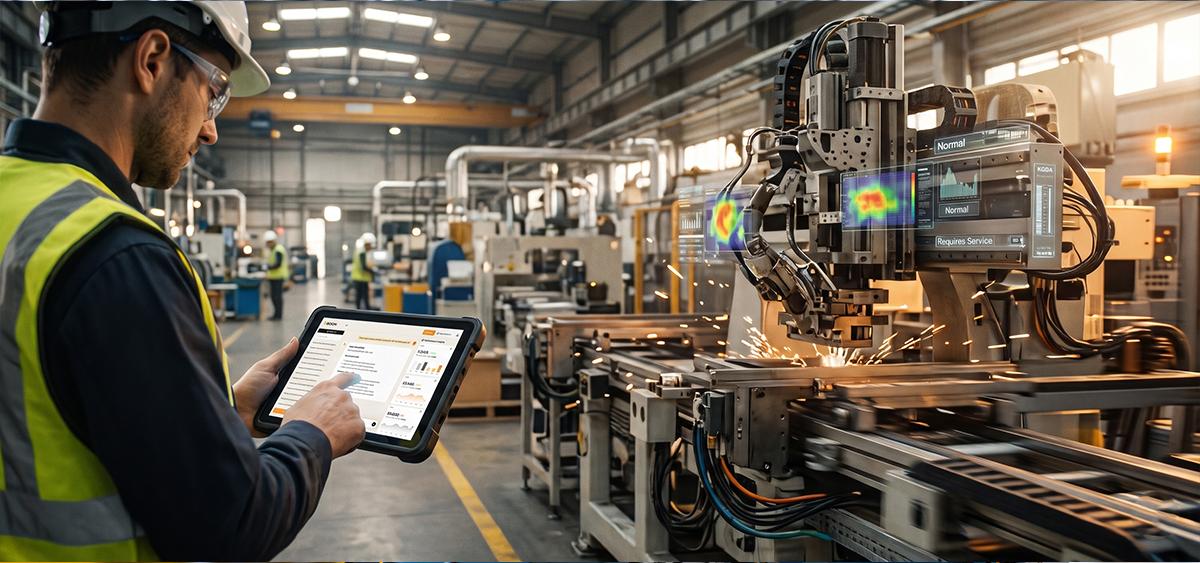

How Can AI Help Prevent Machine Failures and Reduce Downtime?
Imagine a manufacturing facility operating at full capacity. Machines are running, production schedules are on track, and customer orders are being processed without delays.
Suddenly, a critical machine stops working.
Production slows down, maintenance teams rush to identify the problem, and managers begin calculating how the interruption will affect delivery commitments.
For manufacturers, unexpected equipment downtime is more than a technical problem. It can disrupt production, increase maintenance expenses, affect product quality, and reduce overall operational efficiency.
Traditional maintenance methods often focus on repairing equipment after a breakdown or servicing machines according to predetermined schedules. Although these approaches remain important, they may not identify developing equipment problems early enough.
What if manufacturers could recognize warning signs before the machine stopped working?
This is where AI-Powered Predictive Maintenance is changing the way industrial equipment is monitored and maintained.
By combining artificial intelligence, machine learning, and equipment performance data, manufacturers can identify potential failures earlier, improve maintenance planning, and make better decisions about equipment reliability.
Instead of constantly reacting to unexpected breakdowns, businesses can move toward a more proactive and data-driven maintenance strategy.
What Is Predictive Maintenance in Manufacturing?
Predictive maintenance is an equipment maintenance approach that uses operating conditions, historical information, and performance data to identify when machines may require attention.
Unlike traditional maintenance strategies that depend entirely on fixed schedules, predictive maintenance focuses on understanding the actual condition of equipment.
Modern manufacturing facilities generate valuable information through machines, sensors, control systems, and maintenance records.
This information may include:
Equipment temperature and vibration levels.
Machine operating hours and workload.
Motor speed and electrical performance.
Historical equipment failures.
Maintenance and inspection records.
Pressure, lubrication, and operating conditions.
Changes in machine performance over time.
Artificial intelligence can analyze these different data sources to identify unusual patterns that may indicate equipment deterioration.
For example, a motor may begin experiencing higher vibration levels than normal. Although the change might not immediately affect production, it could indicate an emerging mechanical problem.
An AI-based monitoring system may detect the abnormal pattern and provide information that helps maintenance teams decide whether an inspection is necessary.
By recognizing these warning signs, manufacturers can address developing problems before they lead to unexpected equipment failures.
The effectiveness of this approach depends on reliable data, appropriate monitoring technology, and the ability to interpret equipment conditions accurately.
Why Unexpected Equipment Downtime Is a Major Manufacturing Challenge
Manufacturing operations depend on the reliable performance of equipment, production lines, and supporting infrastructure.
When one important machine fails, the impact can extend beyond the equipment itself.
A breakdown in a critical production process may delay several connected activities, affecting the entire manufacturing workflow.
Production Delays
Unexpected equipment failures can interrupt production schedules and prevent manufacturers from completing planned work.
When production depends on interconnected machinery, a single equipment failure may affect multiple processes.
Increased Maintenance Expenses
Emergency repairs often require immediate attention from technicians, maintenance engineers, and external service providers.
Replacement components may need to be sourced urgently, creating additional operational pressure.
Reduced Equipment Reliability
Repeated breakdowns can make production planning difficult.
When equipment performance becomes unpredictable, maintenance teams may spend more time responding to emergencies than improving long-term reliability.
Delivery and Customer Commitments
Production interruptions can affect order completion and delivery schedules.
For manufacturers operating with strict customer deadlines, unexpected downtime can create challenges across supply chain operations.
Pressure on Maintenance Teams
Reactive maintenance environments often require technicians to respond quickly to unexpected failures.
This can reduce the time available for planned inspections, preventive maintenance, and equipment improvement activities.
These challenges explain why manufacturers are increasingly exploring intelligent monitoring and data-driven maintenance strategies.
How Does Artificial Intelligence Predict Machine Failures?
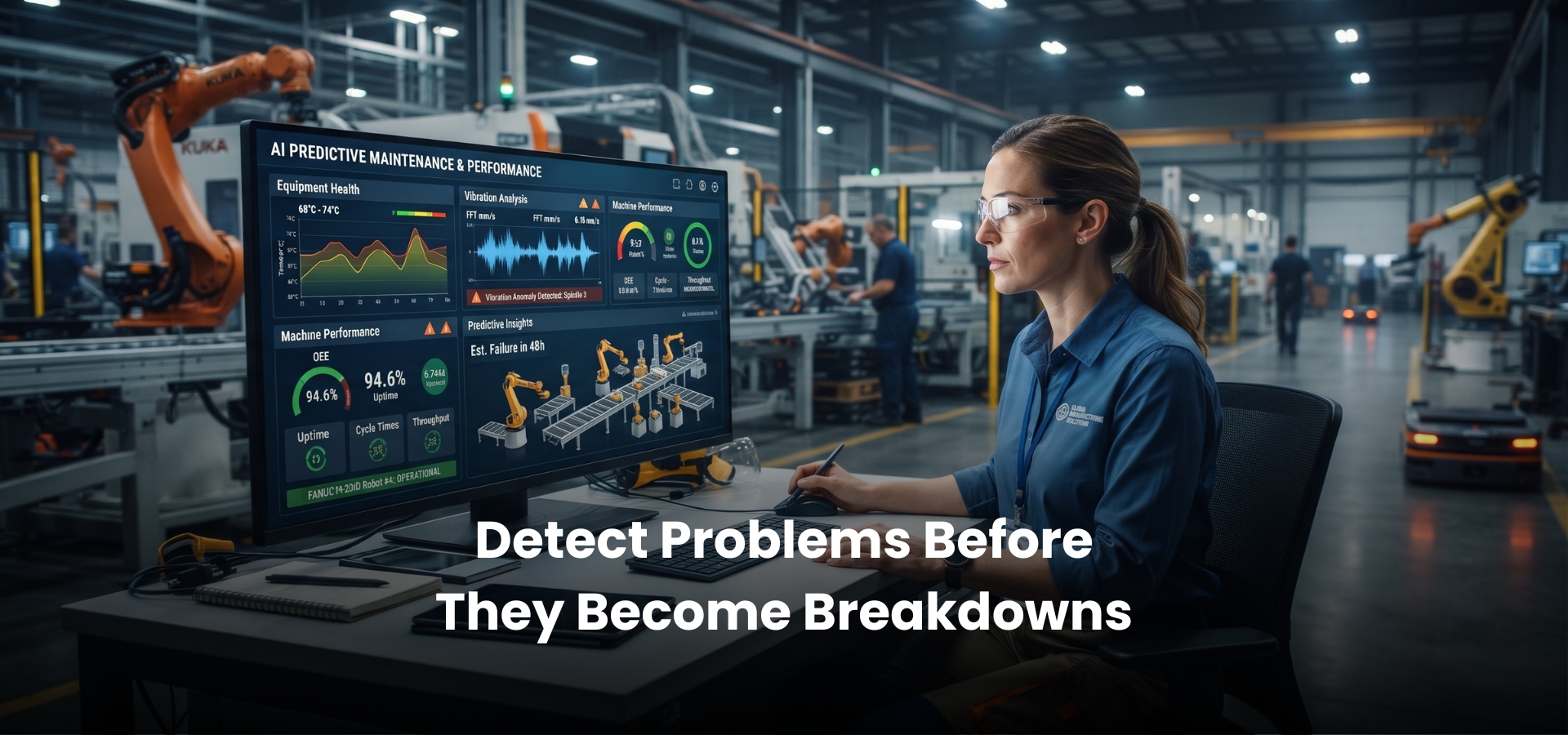
Industrial equipment rarely fails without any preceding changes in its operating condition.
Many mechanical and electrical problems develop gradually, producing signals that may be difficult to recognize through occasional manual inspections.
Artificial intelligence helps manufacturers analyze these signals more systematically.
Collecting Equipment Performance Data
The first step involves collecting relevant information from machines and industrial systems.
Sensors and monitoring devices can capture operating conditions such as temperature, vibration, pressure, and electrical performance.
Historical maintenance records provide additional context for previous breakdowns, repairs, and recurring problems.
Identifying Normal Operating Patterns
Machine learning models can analyze equipment information to identify typical operating behaviors.
For example, a machine may normally operate within a particular temperature range under specific production conditions.
By understanding these patterns, AI systems can help distinguish normal operational changes from unusual behavior.
Detecting Abnormal Equipment Conditions
When machine performance changes significantly, an AI system may identify the variation as a potential warning sign.
Examples include increasing vibration, abnormal energy consumption, unexpected temperature changes, or unusual pressure readings.
Not every abnormal reading indicates an approaching failure. Maintenance teams must consider operating conditions and investigate the findings.
Supporting Maintenance Decisions
When potential problems are detected, maintenance teams can use the available information to prioritize inspections and determine appropriate corrective actions.
For instance, if a bearing begins showing signs of deterioration, technicians may schedule an inspection during a planned maintenance window.
This approach can reduce unnecessary production interruptions while supporting equipment reliability.
How Predictive Maintenance Helps Reduce Equipment Downtime
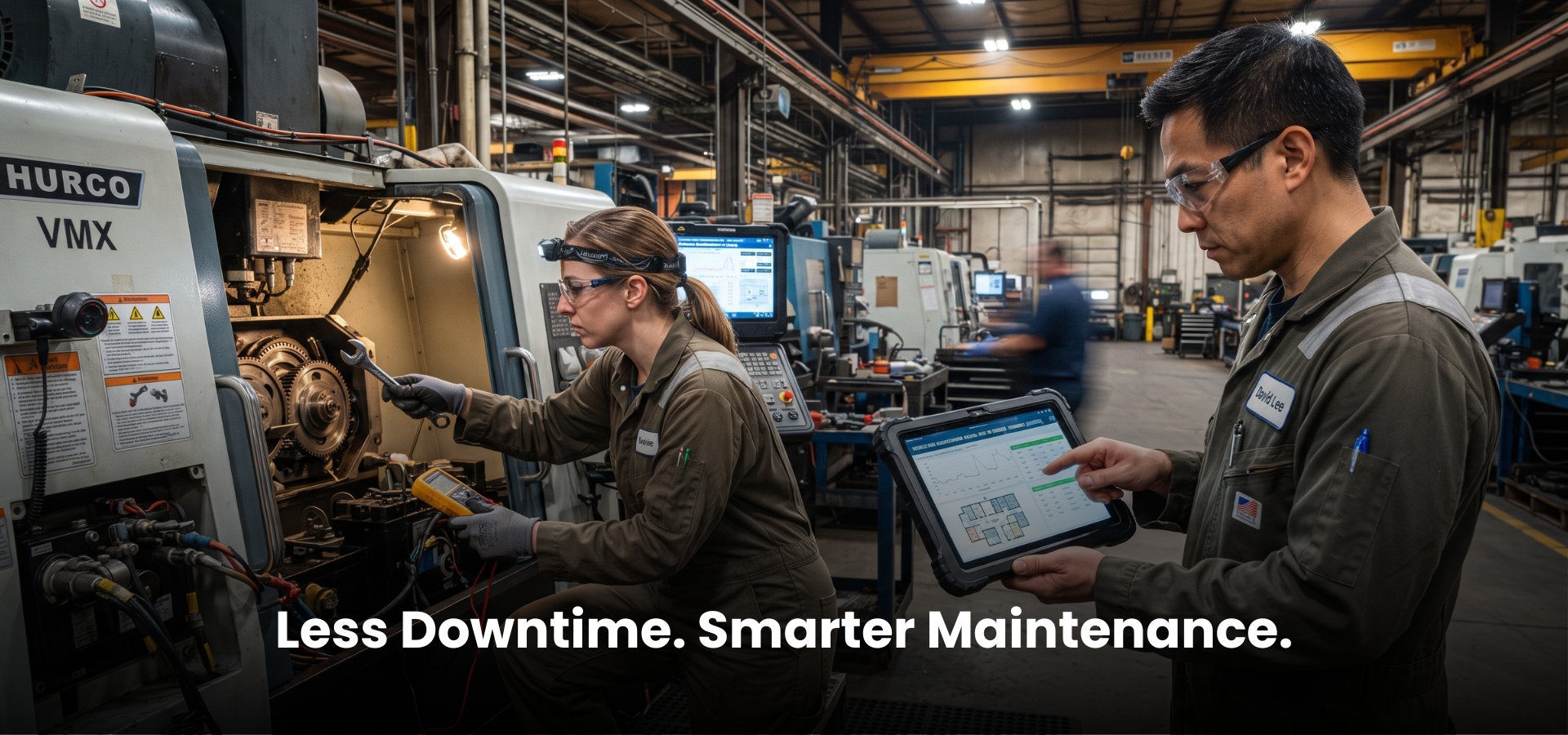
The primary advantage of predictive maintenance is its ability to help manufacturers identify developing equipment problems before they become unexpected breakdowns.
However, its value extends beyond early failure detection.
1. Early Identification of Equipment Problems
Manufacturing equipment can develop faults gradually.
AI-powered monitoring systems can recognize changes in operating patterns that may indicate mechanical wear, electrical problems, or other equipment issues.
Early identification gives maintenance teams more time to investigate potential failures and take appropriate action.
2. Better Maintenance Scheduling
Traditional preventive maintenance generally follows predetermined servicing intervals.
Although scheduled maintenance remains necessary, some equipment may require attention earlier or later than expected.
Predictive maintenance provides additional information about actual equipment conditions.
Manufacturers can use this information to plan inspections, prioritize maintenance tasks, and coordinate repairs with production schedules.
3. Faster Equipment Troubleshooting
When equipment performance deteriorates, maintenance teams must identify the possible cause.
This process may involve reviewing machine history, inspecting components, and analyzing operating conditions.
AI-supported Equipment Failure Diagnosis can help technicians examine relevant information and narrow down possible failure patterns.
By providing additional diagnostic insights, intelligent systems can support more focused troubleshooting and maintenance decisions.
4. Reduced Emergency Maintenance
Unexpected failures frequently require immediate repairs.
Predictive maintenance can help manufacturers identify emerging issues early enough to arrange planned interventions.
This may reduce dependence on emergency maintenance and improve coordination between maintenance and production teams.
5. Improved Equipment Performance
Consistent monitoring provides manufacturers with better visibility in machine conditions.
Maintenance teams can identify recurring abnormalities, investigate deterioration patterns, and address problems affecting equipment performance.
Over time, these practices can support more reliable manufacturing operations.
Predictive Maintenance vs. Preventive Maintenance
Manufacturers often use preventive maintenance and predictive maintenance together, but the two approaches work differently.
Preventive maintenance involves servicing equipment according to predefined schedules or operating intervals.
For example, a machine may undergo an inspection after a certain number of operating hours, regardless of whether a problem has been detected.
Predictive maintenance uses equipment condition information to determine when maintenance may be required.
Preventive Maintenance | Predictive Maintenance |
Follows predetermined schedules | Uses equipment condition data |
Maintenance occurs at fixed intervals | Maintenance is informed by detected risks |
May involve servicing healthy equipment | Helps prioritize equipment requiring attention |
Relies on planned inspections | Uses monitoring and predictive analysis |
Focuses on scheduled prevention | Focuses on detecting developing problems |
Both approaches have advantages.
Preventive maintenance remains essential for routine servicing, safety requirements, and equipment without sufficient monitoring data.
Predictive maintenance adds another level of intelligence by helping manufacturers understand equipment conditions more accurately.
An effective industrial maintenance strategy may combine both approaches based on equipment criticality, operating conditions, and business requirements.
The Role of Machine Learning and Industrial IoT
Artificial intelligence does not work independently of manufacturing infrastructure.
Successful predictive maintenance often depends on connected equipment, reliable data collection, and intelligent analysis.
Industrial Internet of Things technology enables machines and sensors to collect and communicate operating information.
Machine learning algorithms can then analyze this information to identify patterns, anomalies, and potential failure indicators.
For example, connected sensors may continuously monitor a production motor.
If vibration levels increase while operating temperatures also begin rising, an AI system may recognize that the combination deserves further investigation.
Cloud platforms and industrial software applications can help organize this information and make it accessible to maintenance teams.
The growing adoption of AI in Manufacturing is creating opportunities for businesses to use operational data more effectively.
Rather than relying exclusively on manual observations, manufacturers can combine equipment information with engineering expertise to make better maintenance decisions.
However, successful implementation requires reliable connectivity, suitable data infrastructure, appropriate cybersecurity measures, and effective integration with existing industrial systems.
How Root Cause Analysis Improves Equipment Reliability
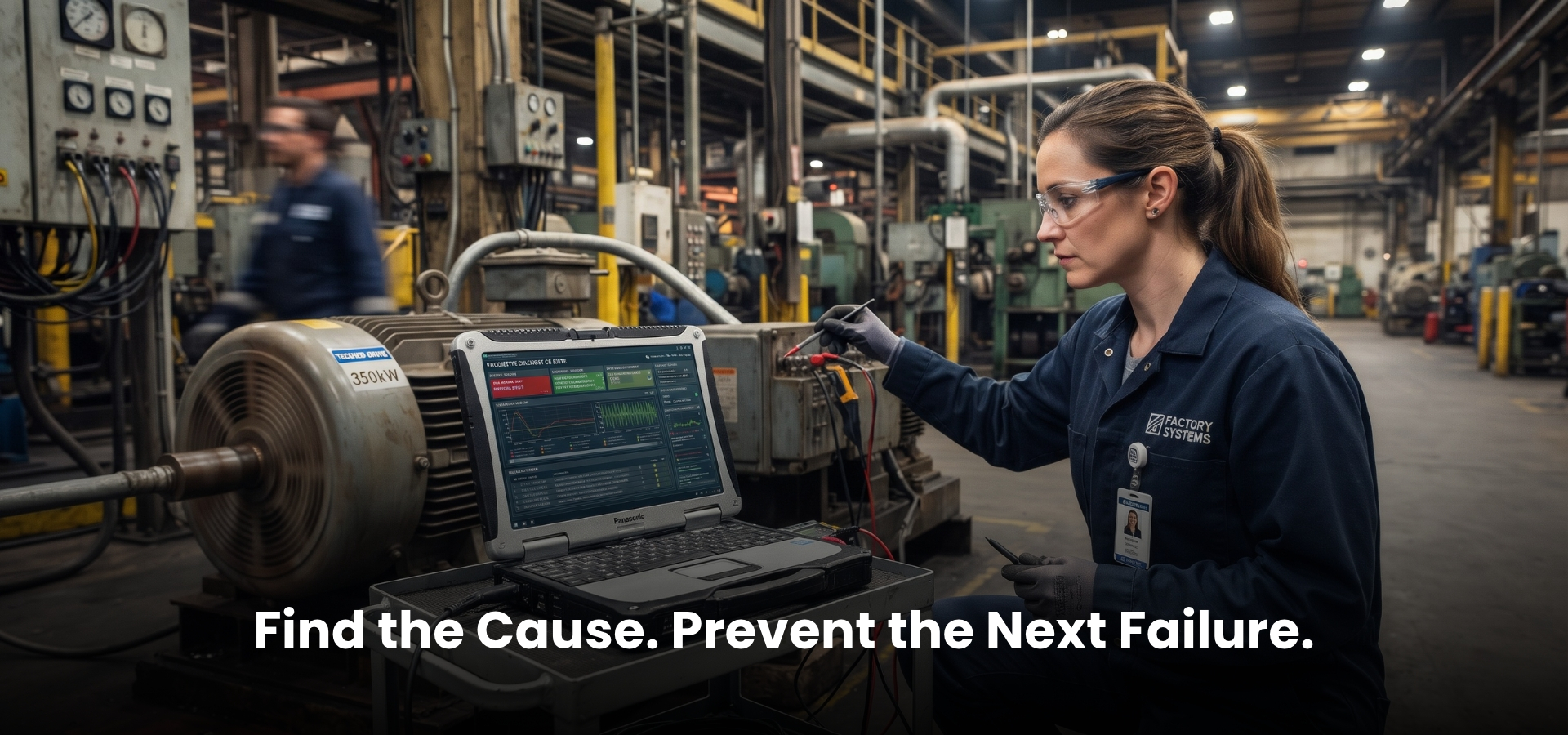
Identifying an approaching equipment failure is important, but manufacturers also need to understand why the problem is developing.
Consider a production motor that repeatedly overheats.
The immediate response may involve cooling the motor or replacing a damaged component.
However, the underlying issue could involve excessive mechanical load, poor ventilation, electrical abnormalities, or another operating condition.
If the actual cause remains unresolved, the same problem may occur again.
This is where AI Root Cause Diagnosis can support industrial maintenance teams.
AI-based analysis can examine equipment performance, historical maintenance information, and recurring fault patterns to help identify possible causes.
Maintenance engineers can use these insights alongside physical inspections and technical expertise to investigate underlying problems.
By understanding recurring equipment failures, manufacturers can improve corrective actions and reduce the likelihood of repeated disruptions.
Root cause analysis also supports continuous improvement by helping organizations identify broader operational issues that affect equipment reliability.
How Predictive Maintenance Can Reduce Operational Costs
Unexpected equipment failures can create several direct and indirect expenses.
Emergency repairs, replacement components, production interruptions, and additional labor requirements may increase overall operating costs.
Predictive maintenance can help manufacturers manage these challenges through better maintenance planning.
Fewer Avoidable Breakdowns
Early identification of developing faults gives maintenance teams opportunities to address potential issues before equipment stops unexpectedly.
More Effective Spare Parts Planning
When maintenance requirements become more predictable, manufacturers may have additional time to arrange necessary replacement components.
This can reduce pressure associated with urgent spare parts procurement.
Better Use of Maintenance Resources
Maintenance teams can prioritize equipment that shows signs of deterioration instead of treating every machine as equally urgent.
This supports more focused inspections and maintenance activities.
Improved Production Planning
Planned maintenance activities are generally easier to coordinate with production schedules than emergency repairs.
Predictive insights can help managers select suitable maintenance windows.
Longer Equipment Service Life
Timely identification and correction of certain operating problems may help prevent avoidable equipment damage.
However, the financial benefits of predictive maintenance vary depending on equipment type, implementation costs, data quality, and maintenance practices.
Manufacturers should evaluate the results using actual operational performance rather than assuming guaranteed savings.
Which Manufacturing Industries Can Benefit?
Predictive maintenance can support different manufacturing environments, particularly where equipment reliability is essential for continuous operations.
Automotive Manufacturing
Automotive production facilities depend on robotic systems, conveyors, machining equipment, and automated assembly lines.
Monitoring critical equipment can help identify developing problems and reduce the risk of unexpected production interruptions.
Food and Beverage Manufacturing
Food processing facilities use motors, pumps, compressors, refrigeration systems, and packaging equipment.
Predictive monitoring can help maintenance teams identify abnormal operating conditions and schedule appropriate inspections.
Pharmaceutical Manufacturing
Pharmaceutical production requires reliable equipment performance and controls operating processes.
Predictive maintenance can support equipment monitoring while working alongside established validation, quality, and maintenance requirements.
Steel and Metal Manufacturing
Heavy industrial equipment operates under demanding conditions involving heat, pressure, vibration, and continuous mechanical loads.
Monitoring equipment performance can help maintenance teams identify deterioration patterns in critical machinery.
Electronics Manufacturing
Electronics production often involves automated assembly systems, precision equipment, and tightly coordinated production processes.
Predictive maintenance can support equipment availability and help reduce disruptions affecting manufacturing schedules.
The specific approach should always reflect each industry's equipment characteristics, operational risks, and maintenance requirements.
Common Challenges in Implementing Predictive Maintenance
Although predictive maintenance offers valuable opportunities, implementation requires careful planning.
Manufacturers should understand the challenges before investing in AI-driven monitoring systems.
Poor Equipment Data Quality
AI systems depend on relevant and reliable information.
Incomplete maintenance records, inaccurate sensor readings, or inconsistent equipment data can reduce the usefulness of predictive insights.
Integration With Existing Systems
Manufacturing facilities may operate a combination of modern equipment, legacy machinery, and different software platforms.
Connecting these systems can require additional engineering and integration of work.
Limited Historical Failure Data
Some predictive models require examples of previous equipment failures to recognize relevant patterns.
When historical information is limited, manufacturers may need alternative monitoring approaches or additional data collection.
False Alerts and Missed Failures
Predictive systems can produce incorrect warnings or fail to detect certain problems.
Regular evaluation and maintenance team feedback are necessary to improve performance.
Employee Adoption
Maintenance engineers and technicians need to understand how AI-generated insights should be interpreted and used.
Training and clear workflows help ensure that predictive monitoring supports existing maintenance practices.
Addressing these challenges can improve the long-term effectiveness of an AI-driven maintenance strategy.
How Manufacturers Can Get Started with Predictive Maintenance
Implementing predictive maintenance does not necessarily require transforming an entire manufacturing facility at once.
A focused approach can help businesses evaluate technology and identify practical opportunities.
Step 1: Identify Critical Equipment
Begin by identifying machines whose unexpected failure would significantly affect production, safety, or operating costs.
Equipment criticality helps determine where predictive monitoring may provide the greatest operational value.
Step 2: Review Available Data
Evaluate existing sensor information, maintenance records, machine logs, and operational systems.
Determine whether the available information is sufficient for meaningful analysis.
Step 3: Define Maintenance Objectives
Manufacturers should establish clear objectives before implementing predictive technologies.
These may include reducing unplanned downtime, improving equipment availability, or supporting faster troubleshooting.
Step 4: Select Appropriate Technology
Choose monitoring systems, data platforms, and AI capabilities based on equipment requirements and existing infrastructure.
Not every machine requires the same predictive approach.
Step 5: Start With a Pilot Project
A pilot implementation allows manufacturers to evaluate predictive monitoring on selected equipment.
Maintenance teams can assess the usefulness of alerts, the accuracy of detected patterns, and the practical impact on maintenance workflows.
Step 6: Evaluate and Expand
After reviewing the pilot results, manufacturers can refine the system and consider expanding monitoring to additional equipment.
A gradual approach can help reduce implementation risks and support better adoption.
How Approlabs Supports Smarter Manufacturing Operations
As manufacturing operations become increasingly data-driven, businesses need technology solutions that connect information, improve visibility, and support better operational decisions.
Approlabs brings expertise in artificial intelligence, custom software development, enterprise applications, workflow automation, and cloud integration.
These capabilities are relevant to manufacturers exploring intelligent maintenance and operational software solutions.
Depending on business requirements, Industrial Maintenance Solutions may involve integrating equipment information, developing monitoring applications, building operational dashboards, or connecting maintenance workflows with existing enterprise systems.
Approlabs' technology engineering expertise can support the design and development of software solutions aligned with specific manufacturing challenges.
Potential project requirements may include:
Integrating operational data from different systems.
Developing AI-enabled analytics applications.
Creating maintenance monitoring dashboards.
Automating maintenance-related workflows.
Connecting industrial applications with enterprise platforms.
Improving access to equipment performance information.
Every manufacturing environment has different equipment, infrastructure, and operational requirements.
A successful technology initiative should therefore begin with a clear understanding of the business problem, available data, and expected outcomes.
By combining software engineering with AI and automation capabilities, Approlabs can help manufacturers explore practical approaches to digital transformation and intelligent operations.
The Future of Predictive Maintenance in Manufacturing
Industrial maintenance is gradually moving toward more connected, intelligent, and data-driven operations.
As manufacturing technologies evolve, AI-powered systems may become better at analyzing equipment conditions and supporting maintenance decisions.
Several developments are influencing this transformation.
Connected equipment monitoring: Industrial IoT technologies can make equipment information more accessible across manufacturing facilities.
Advanced machine learning: Improvements in AI models may support more sophisticated anomaly detection and equipment condition analysis.
Intelligent maintenance workflows: Integration between monitoring systems and maintenance applications can help teams coordinate inspections, work orders, and corrective actions.
Cloud-based industrial analytics: Cloud platforms can support centralized data processing and equipment performance visibility across multiple facilities.
Human-AI collaboration: Maintenance engineers will continue to play an essential role in interpreting equipment conditions, validating findings, and deciding how to respond.
The future of predictive maintenance is not simply about replacing manual maintenance with artificial intelligence.
It is about combining technology, operational information, and engineering expertise to make maintenance more proactive and effective.
Final Thoughts
Unexpected equipment downtime remains a significant challenge for manufacturers seeking consistent productivity and operational efficiency.
Traditional maintenance methods provide an important foundation, but AI-powered predictive maintenance offers additional opportunities to identify developing equipment problems earlier.
By analyzing machine performance, detecting unusual operating patterns, and supporting maintenance decisions, AI can help manufacturers reduce avoidable breakdowns and improve equipment reliability.
The greatest value comes when predictive insights are combined with experienced maintenance professionals, reliable equipment data, and well-organized maintenance processes.
For manufacturers planning their next stage of digital transformation, intelligent maintenance technology can be an important step toward more resilient operations.
Ready to explore smarter manufacturing solutions?
Connect with Approlabs to discover how AI development, custom software engineering, and workflow automation can support your manufacturing operations.
.
AUTHOR

Marketing team.