How AI Is Transforming Aviation Email and Flight Permit Operations
Discover how AI is transforming aviation email management and flight permit processing through smarter automation, document extraction, and efficient workflows.


Why Is Aviation Email Management Important?
Imagine an aviation operations team preparing an international charter flight. The aircraft is scheduled to depart the following morning, and the team is coordinating several activities before departure.
The flight route has been reviewed. Ground handling arrangements are being confirmed. Supporting aircraft documents have been collected. The operations team is waiting for responses relating to the required flight permits.
Then an email arrives requesting updated aircraft information.
A few minutes later, another message contains a revised departure schedule. A third email includes a document attachment, while a separate conversation contains information about the aircraft's planned arrival.
Every message is important, but the details are spread across different emails, attachments, and conversations.
The operations team must identify which messages relate to the flight, determine what has changed, and ensure that the correct information is available to the people responsible for acting.
This is a common challenge in aviation administration.
Aviation operations depend on accurate information and effective communication. Airlines, private aviation operators, charter companies, flight support providers, ground handling teams, and aviation authorities exchange large amounts of operational information.
Although aviation organizations use specialized software for flight planning and operations management, email remains an important communication channel.
It is used to exchange documents, coordinate services, communicate schedule changes, and manage requests that require attention from external organizations.
The challenge is that email communication is often unstructured.
One sender may include flight details directly in the email body. Another may attach a PDF. A third may provide information in a spreadsheet or scanned document.
The same operational information can appear in different formats, making it difficult to process consistently.

Why email is important in daily aviation operations
Email helps aviation organizations communicate with people and businesses that may not use the same internal systems.
For example, a charter operator may use one platform to manage flight schedules, while a ground handling provider uses a different application.
An aviation authority may require permit information through a specific submission channel.
Email can help coordinate these activities, but the information must still be reviewed and recorded accurately.
Aviation teams commonly use email for flight-related communication such as aircraft documentation, permit coordination, airport handling arrangements, schedule updates, and service confirmations.
Each type of communication may require a different response.
A permit of confirmation must be reviewed to establish whether the authorization applies to the intended flight.
A schedule update may require coordination with several service providers.
A missing document request may need immediate attention from the employee responsible for aircraft records.
These are not simply messages to read. They are pieces of information connected to operational responsibilities.
Why manual email management becomes difficult
The problem becomes more noticeable when an organization manages several flights simultaneously.
Employees may need to switch between email inboxes, flight operations software, document folders, and internal tracking systems.
They must identify the correct flight, compare information, and determine whether the message requires action.
When an employee receives a document, they may need to open it, locate the relevant details, and manually transfer the information into another application.
If the same information is required by multiple departments, the work may be repeated.
This creates administrative pressure, particularly during busy operational periods.
Long email conversations can make the situation more complicated.
A permit request may begin with an initial application, followed by several messages requesting clarification or providing updated documents.
The most recent message does not always contain the complete operational context.
Employees may need to review earlier communication to understand the request.
How AI can improve aviation email management
Artificial intelligence offers a different approach to handling these messages.
Instead of requiring employees to read and organize every incoming email manually, AI-powered systems can assist with identifying message categories and extracting relevant information.
For example, an AI system may recognize that an incoming message relates to a flight permit request.
It can identify selected flight details, associate the message with a relevant operational record, and prepare the information for review.
If an attachment contains aircraft information, document processing technology may help extract the required fields.
When information is missing or uncertain, the system can flag the issue for an employee.
This allows aviation teams to focus more attention on verification and operational decisions rather than repetitive information collection.
The objective is not to remove people from aviation communication.
It is to make information easier to find, understand, and use.
As aviation organizations continue to adopt digital technologies, aviation email automation is becoming an important opportunity for improving administrative efficiency.
How Do Aviation Teams Manage Emails?

Aviation teams handle emails through a combination of individual inboxes, shared mailboxes, operational systems, and internal communication procedures.
The exact approach depends on the organization's size and activities.
A small private aviation operator may have a limited operations team responsible for several administrative tasks.
A larger flight support company may employ different teams for permits, scheduling, ground handling, documentation, and customer coordination.
Despite these differences, the basic email management process often involves similar activities.
Receiving operational emails
The process begins when an email reaches the organization's inbox.
The message may come from an aviation authority, airport representative, service provider, aircraft operator, customer, or internal department.
Employees must determine whether the message relates to an existing flight or a new request.
For example, a ground handling provider may send confirmation of services for an upcoming arrival.
The operations team must identify the aircraft and flight schedule associated with that confirmation.
If the email contains an attachment, the employee may also need to review the document.
Identifying the purpose of the message
Not every email requires the same level of attention.
Some messages provide routine information.
Others contain changes that may affect flight planning or permit coordination.
Aviation teams must distinguish between these situations.
A message confirming receipt of a document may require little additional work.
A message requesting corrected aircraft details may require the team to investigate the information and respond.
The ability to recognize the purpose of a message is therefore essential.
Manual classification depends on employees' reading and interpreting the content.
AI-powered email classification can help organize messages into categories such as permit requests, document updates, schedule changes, and operational confirmations.
Checking flight information
After identifying the purpose of the email, employees may need to verify the information against existing records.
An email might refer to an aircraft's registration, flight number, departure airport, or planned operating date.
The team must ensure that the information corresponds to the correct flight.
This becomes particularly important when an operator manages several aircraft or repeated flights between the same airports.
A similar flight number or schedule does not necessarily mean two messages refer to the same operation.
Employees must consider the complete context.
Forwarding requests to the correct team
Many aviation emails require action from another department.
For example, a request for updated aircraft documentation may need to be handled by the records or compliance team.
A schedule of change may require coordination with flight operations.
A question about airport services may need attention from the ground handling coordinator.
In a manual workflow, employees forward the email and explain the required action.
This creates additional communication.
If the recipient is unavailable, the request may remain pending.
Structured workflow systems can help assign responsibility and track progress.
Recording completed actions
After a request is handled, the outcome may need to be recorded.
For example, an employee may receive a permit-related response and update the relevant tracking record.
Another employee may confirm that a supporting document has been submitted.
These updates are important for maintaining operational continuity.
Without centralized tracking, employees may need to search through email conversations to understand what has already been completed.
Managing communication across shifts
Aviation operations may continue outside normal office hours.
Different employees may manage the same flight during different shifts.
This creates a need for clear handovers.
An employee beginning a shift should be able to identify pending requests, important updates, and outstanding actions.
If information remains only in individual inboxes, the incoming team may spend additional time reconstructing the situation.
A centralized email workflow can help maintain a shared operational history.
AI can support this process by organizing relevant communication and preparing information for review.
The result is a more consistent approach to handling operational emails, even when responsibilities move between employees.
What Is Flight Permits?

Flight permits are authorizations that may be required for certain aircraft operations within or through a country's airspace.
They form part of the regulatory and administrative requirements associated with international aviation.
The need for a permit depends on several factors, including the country involved, aircraft operator, flight purpose, route, and applicable aviation arrangements.
Not every international flight requires a separate permit from every country it crosses.
Some operations are covered by established permissions, agreements, or exemptions.
Other flights require an application before the operation can take place.
Aviation teams must determine which requirements apply to the specific flight.
Understanding flight permits in simple terms
Consider an aircraft operating an international charter flight.
The planned route may pass through several countries before reaching the destination.
Depending on the applicable rules, the operator may need permission to cross certain national airspaces.
If the aircraft is scheduled to land in another country, additional authorization may be required.
The operator must identify these requirements during flight planning.
When a permit is necessary, the relevant information must be submitted through the appropriate procedure.
The authority may review the request and communicate its decision.
Why permit information must be accurate
A permit application may contain details about the aircraft, operator, schedule, and intended operation.
These details must be consistent with the supporting documents and the actual planned flight.
For example, the application may identify a particular aircraft registration.
If the operator later substitutes another aircraft, the existing authorization may no longer apply in the same way.
The operations team must determine whether an amendment or a new application is required.
The same issue can arise when flight dates, routes, or other important details change.
This is why permit coordination requires ongoing information management rather than a single submission.
How email is involved in permit coordination
Permit-related communication may occur through email, portals, authorized representatives, or other channels established by the relevant authority.
When email is used, the conversation may include application details, document requests, clarifications, and authorization notices.
Each message contributes to the overall permit record.
Employees must understand how the messages relate to one another.
For example, an initial application may be followed by a request for additional documentation.
The operator submits the document and waits for further communication.
If the authority later issues an authorization, the team must verify the details and any applicable conditions.
Aviation email automation can help organize this correspondence.
It can assist with identifying permit-related messages and associating them with the correct request.
However, an AI classification or summary must never be treated as a substitute for verifying the actual authorization.
Why permit coordination matters
Permit coordination affects flight readiness and operational planning.
If required permissions are not obtained, the operator may need to delay or revise the flight.
This can affect other arrangements, including airport services and customer schedules.
Reliable permit management therefore depends on understanding regulatory requirements, preparing accurate information, and maintaining clear communication.
AI can support the administrative aspects of this process, but the regulatory responsibility remains with the operator and relevant authorities.
Why Do Flights Need Permits?
Countries regulate aviation activities within their jurisdiction according to applicable national and international frameworks.
Flight permits are one of the mechanisms through which certain operations may require authorization.
The requirements can vary according to the nature of the flight.
Commercial air transport, private flights, charter operations, cargo movements, and special-purpose flights may be subject to different procedures.
For aviation organizations operating internationally, this creates a need for careful planning.
Regulatory requirements differ between countries
An operator cannot assume that the same permit rules apply everywhere.
One country may require an application for a particular non-scheduled operation.
Another may have different arrangements or exemptions.
The required supporting information and submission procedures may also differ.
This means that aviation teams must understand the rules that apply to each intended operation.
Permit coordination is therefore closely connected to route planning.
Before a flight is confirmed, the team may need to determine whether the planned route involves countries where additional permissions are necessary.
Permits support authorized operations
Where permits are required, they help establish that the relevant authority has authorized the intended activity under applicable conditions.
An authorization may relate to a particular aircraft, route, operating period, or type of flight.
The precise scope depends on the permission issued.
Operations teams must review these details carefully.
A permit that applies to one flight should not automatically be assumed to cover another operation.
Flight changes can affect permit requirements
Aviation schedules are not always fixed.
Weather, aircraft availability, customer requirements, airport restrictions, and other operational circumstances may lead to changes.
A departure may be postponed.
An aircraft may be replaced.
A route may need to be adjusted.
When these changes occur, the operations team must review the implications for existing permissions.
Some changes may be allowed under the relevant authorization.
Others may require notification, amendment, or a new application.
The appropriate action depends on the applicable rules.
Why permit management requires coordination
Flight permits are connected to other operational activities.
For example, a revised route may affect the countries involved in the flight.
A change in aircraft registration may require updated supporting information.
A schedule of adjustment may affect airport handling arrangements.
The permit team must communicate with other departments to ensure that the information remains consistent.
When this coordination depends entirely on manual emails, it can create unnecessary administrative effort.
AI-supported workflows can help identify relevant changes and notify responsible employees.
However, determining the regulatory consequences of a change requires appropriate expertise.
The value of AI is helping teams manage information more efficiently, not replacing the authorization process.
What Are the Types of Flight Permits?
Flight permit terminology and requirements vary by jurisdiction.
Nevertheless, aviation professionals commonly encounter several categories of permission when planning international operations.
Understanding the differences helps teams organize documentation and communication.
Overflight permits
An overflight permit may be required when an aircraft intends to pass through a country's airspace without landing.
The applicable requirement depends on the country, the type of operation, and any relevant agreements or exemptions.
When an application is required, the operator may need to provide aircraft details, routing information, flight timing, and other supporting information.
For flights crossing multiple countries, the operations team must assess each relevant jurisdiction.
This can involve managing several separate requests.
The challenge becomes greater when the planned route changes.
An alternative route may introduce different permit requirements.
The team must therefore coordinate permit information with the current flight plan.
Landing permits
A landing permit may be required for certain aircraft operations arriving in a country.
Requirements may differ between scheduled commercial services, non-scheduled charter flights, private operations, and other flight categories.
The application may involve information about the aircraft, operator, schedule, destination, and purpose of the flight.
Aviation teams must ensure that the details are consistent with the intended operation.
If the destination or schedule changes, the team may need to review the authorization.
Special flight authorizations
Certain operations may require special permissions because they fall outside standard operating arrangements.
For example, a ferry flight involving an aircraft that does not meet ordinary airworthiness requirements may require a special flight authorization under the applicable rules.
These authorizations are distinct from ordinary overflight or landing permits.
The conditions and supporting documentation depend on the regulatory framework.
Traffic rights and commercial permissions
Some international commercial operations involve permissions associated with traffic rights or specific commercial activities.
These should not be confused with routine flight permits.
An operator may need to satisfy separate regulatory requirements before conducting a particular service.
Aviation teams must identify which permissions apply rather than if one authorization covers every requirement.
Additional operational permissions
Certain flights may involve restricted airspace, unusual cargo, special activities, or other circumstances requiring additional coordination.
The applicable procedures vary.
For this reason, aviation organizations benefit from maintaining accurate records of permit categories and supporting requirements.
How AI helps organize permit information
Different permit types may involve different document lists, reference numbers, and communication procedures.
An AI-powered email system can help classify incoming messages according to the relevant workflow.
For example, it may distinguish an overflight permit inquiry from a landing permit document request.
It can also extract selected information and prepare it for review.
This reduces repetitive sorting and data entry.
However, the system should not independently determine whether a permit is unnecessary or that an authorization has been granted.
Those conclusions must follow verified regulatory requirements and reliable sources of information.
How Does Flight Permit Processing Work?

Flight permit processing is a coordinated administrative activity involving information collection, document preparation, submission, communication, and verification.
The exact process depends on the relevant authority and the type of operation.
Some authorities provide online application systems.
Others use established submission channels or authorized representatives.
Despite these differences, several common activities appear throughout the workflow.
Step 1: Review the planned flight
The process begins with understanding the intended operation.
The team reviews the aircraft, route, departure and arrival of airports, flight purpose, and planned schedule.
This information helps determine which authorizations may be required.
For example, an international charter flight may involve multiple jurisdictions.
The operations team must assess the requirements associated with the intended route and destination.
Step 2: Identify the relevant authorities
Once the requirements are understood, the team identifies the organizations responsible for the applicable permissions.
Different authorities may use different procedures.
Employees must ensure that requests are directed through the correct channels.
Using an outdated contact or incorrect submission method can create avoidable delays.
Step 3: Collect required information
Permitting applications often depends on information already maintained by the operator.
This may include aircraft registration, operator details, planned routing, schedule information, and supporting documents.
The challenge is that the information may be stored in different systems.
Flight schedules may be maintained in an operations platform.
Aircraft documents may be stored in a document repository.
Previous permit correspondence may remain in email.
Employees must bring the relevant information together.
Step 4: Prepare the request
The team organizes the information according to the authority's requirements.
Some applications use structured forms.
Others may require supporting documents or additional explanations.
Accuracy is important because incomplete or inconsistent information can lead to follow-up requests.
A structured preparation process can help reduce avoidable mistakes.
Step 5: Submit through the approved channel
The request is submitted using the procedure established by the authority.
The team may receive a reference number, acknowledgement, or other confirmation.
These details should be recorded where appropriate.
An acknowledgement of receipt should not be confused with an authorization to operate.
Step 6: Monitor the response
After submission, the team monitors the request.
The authority may request clarification, additional documentation, or revised information.
Employees must identify these messages and respond through the appropriate process.
This is one area where manual email management can become time-consuming.
Aviation teams may need to search inboxes to determine whether a response has arrived.
Step 7: Verify the authorization
When an authorization is issued, the team must verify that it applies to the intended operation.
Relevant details and conditions should be reviewed.
The authorization should be recorded and made available to the personnel responsible for the flight.
Step 8: Manage amendments
If flight information changes, the team must determine whether the authorization remains applicable.
Any required amendment or resubmission should follow the relevant procedure.
Where AI fits into the workflow
AI can assist with several administrative stages.
It may help extract information from incoming requests, identify relevant attachments, and organize communication.
It can also support completeness checks and route follow-up messages to responsible employees.
For example, a document request received after submission can be associated with the original permit record.
The system may then create a review task.
This reduces the need to manually search for related correspondence.
A well-designed workflow can provide clearer visibility to the administrative status of requests.
However, the system should distinguish between internal processing status and the official status communicated by the authority.
This distinction is essential for reliable permit management.
Why Are Flight Permits Delayed?

Flight permit delays can affect international aviation planning.
However, not every delay has the same cause.
Some delays arise from regulatory review, operational restrictions, or circumstances outside the operator's control.
Others result from incomplete applications, communication problems, or administrative inefficiencies.
Understanding the source of a delay helps aviation organizations identify where improvements are possible.
Missing application information
One common administrative problem is incomplete information.
A permit request may be missing an aircraft in detail, schedule of reference, or required supporting document.
When this happens, the authority may request additional information before continuing its review.
The operations team must locate the missing information and submit it.
If the required document is stored in another system or held by another department, the process may take longer.
AI-supported document management can help identify expected information before submission.
Incorrect or inconsistent details
A permit application may contain information that differs from the supporting records.
For example, the aircraft registration shown in the request may not match the registration in an attached document.
A schedule may contain conflicting dates.
An operator's name may be presented inconsistently.
These differences can create uncertainty and require clarification.
Automated validation can help identify selected discrepancies.
However, the system must use reliable reference data and appropriate rules.
Changes to flight schedules
Flight schedules can change for operational reasons.
A departure may be delayed, an arrival time revised, or a flight moved to another date.
The operations team must assess whether these changes affect the permit request or authorization.
If an amendment is required, additional communication may be necessary.
Aircraft substitutions
An operator may need to replace the originally planned aircraft.
This can affect the details associated with the permit.
The team must review whether the existing authorization remains applicable.
Updated documents may also be required.
When information is spread across multiple systems, preparing the revised request can involve additional manual work.
Delayed responses to authority requests
An authority may request clarification or additional documents.
If the message is overlooked, the response may be delayed.
This is particularly relevant when operational inboxes receive many unrelated emails.
AI email classification can help highlight messages requiring action.
Difficulty locating documents
Aircraft records may be stored in different folders, repositories, or internal systems.
Employees may spend time searching for the correct version of a document.
A centralized document management process can reduce this effort.
AI can assist with document identification and selected information extraction.
Unclear internal responsibilities
Permit coordination may involve flight operations, compliance, records management, and other departments.
If responsibility for a request is unclear, employees may assume another team is handling it.
Structured workflows can help establish ownership.
External regulatory processing
Some delays arise from the authority's own review process.
These cannot necessarily be reduced through internal automation.
An AI system cannot guarantee that a permit will be approved, or that an authority will respond within a particular period.
The realistic benefit of AI is reducing avoidable administrative delays within the operator's workflow.
What Are Common Aviation Email Problems?
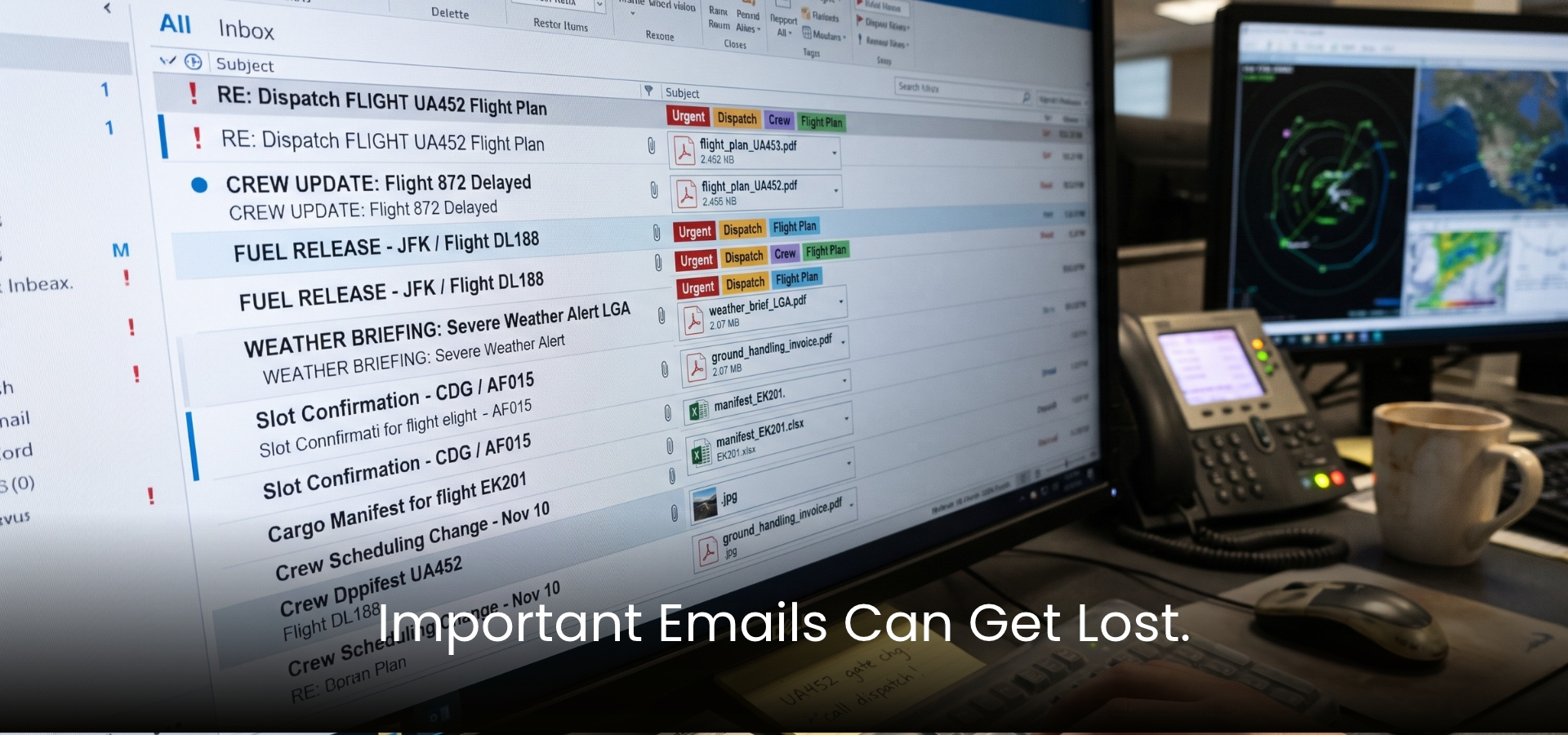
Aviation email management becomes difficult when operational communication is frequent, time-sensitive, and spread across multiple sources.
The following problems can affect both small and large aviation organizations.
Too many emails in one inbox
A shared operations inbox may receive permit correspondence, service confirmations, customer requests, document updates, and general messages.
Employees must identify which emails are relevant.
When the inbox is busy, important requests may be difficult to distinguish from routine communication.
Important information hidden in email threads
An operational conversation may continue across several messages.
The latest email may refer to information shared earlier.
Employees must review the conversation to understand the context.
For example, a message stating that revised documents have been accepted may not identify every document in the latest reply.
The employee may need to inspect earlier messages.
Different email formats
Aviation organizations communicate with different parties.
Some use standardized templates.
Others write free-form messages.
The same type of request may be expressed in several ways.
This makes simple keyword-based sorting less reliable.
AI classification can help recognize the purpose of messages based on context.
Attachments that require manual review
Documents may arrive as PDFs, spreadsheets, images, or scanned files.
Employees must open the attachments and locate relevant information.
If a document contains several pages, this can take additional time.
Repeated data entry
Flight details may be copied from emails into spreadsheets or operational systems.
The same information may be entered more than once.
This increases administrative workload and creates opportunities for inconsistent records.
Duplicate communication
Several employees may receive the same message.
Without clear ownership, more than one person may respond or update the same record.
A centralized workflow can help reduce duplication.
Missing attachments
A sender may refer to a document without including it.
Employees must identify the omission and request the file.
Automated checks can help flag emails that appear to reference missing attachments, although such detection is not always reliable.
Incorrect flight identification
An email may contain incomplete flight details.
If the system or employee associates it with the wrong operation, the information may be recorded incorrectly.
Reliable matching requires appropriate validation.
Limited visibility into pending work
When tasks are managed through email alone, supervisors may have difficulty identifying outstanding requests.
A structured workflow can show which items are awaiting review or action.
Challenges during shift changes
Employees may need to explain the status of several ongoing requests.
If the information is not recorded consistently, the incoming team may need to repeat earlier searches.
These problems demonstrate why aviation organizations benefit from treating email as a source of operational information rather than only a communication tool.
AI can help organize this information, but reliable workflows still require clear responsibilities and human review.
How Does Manual Email Processing Affect Flights?
Manual email processing can influence the efficiency of several activities involved in preparing and supporting flights.
The effect is not limited to the time employees spend reading messages.
It also includes the effort required to verify information, coordinate departments, and maintain accurate operational records.
Consider a flight support company managing several international movements.
Each flight may involve different airports, service providers, schedules, and regulatory requirements.
The company receives communication from multiple organizations throughout the day.
One email confirms an airport service.
Another requests updated aircraft documentation.
A third contains revised flight timing.
A fourth provides information about a pending permit application.
Employees must understand which message belongs to which flight and determine whether any action is required.
Repeated information collection
When operational details are spread across emails, employees may repeatedly search for information that has already been provided.
For example, aircraft registration may appear in the original flight request, a permit application, and several service confirmations.
If the organization does not maintain a centralized record, employees may need to locate the same information multiple times.
This repetition increases workload.
It can also create inconsistencies when different employees use different versions of the information.
Delays in responding to changes
Flight operations are dynamic.
Schedules, aircraft assignments, and service requirements may change.
When an important update arrives, the team must identify and determine its implications.
If the message is not reviewed promptly, the corresponding administrative action may also be delayed.
For example, a revised flight schedule may require the operations team to review permit validity and notify relevant service providers.
A delay in recognizing the change can complicate coordination.
AI-powered email monitoring can help identify messages containing operational changes.
The system can then direct them to authorized employees for review.
Increased risk of inconsistent records
Manual data entry creates opportunities for mistakes.
An employee may copy an incorrect date, omit a character from an aircraft's registration, or enter information into the wrong flight record.
These errors may require additional investigation.
When the same information is entered into several applications, correcting it can become more complicated.
Automated data extraction and controlled integration can help reduce repeated entry.
However, the information must still be validated before it updates important operational records.
Communication gaps between departments
Aviation operations involve several teams.
Flight planning, permit coordination, ground handling, aircraft records, and customer communication may be managed separately.
An update received by one department may be relevant to another.
If the information is not shared effectively, employees may continue working with outdated details.
A centralized workflow can help make relevant updates visible to the responsible teams.
For example, a document-related request can be assigned to records management while the permit coordination team retains visibility into its progress.
Difficulties during urgent operations
Urgent requests create additional pressure.
A last-minute charter operation may require employees to collect information and coordinate several activities within a limited period.
During these situations, manually searching for documents and reviewing long email conversations can consume valuable time.
AI can help by organizing available information and identifying messages requiring attention.
Nevertheless, the urgency of an operation should not reduce the need for accurate verification.
Limited operational reporting
When administrative activities are managed entirely through email, organizations may struggle to measure their performance.
Managers may not know how many permit-related requests are awaiting action, or which document categories create the most administrative work.
Structured workflows can provide better information about these activities.
Organizations can use this information to identify recurring problems and evaluate improvements.
The main benefit of reducing manual email processing is therefore not simply saving time.
It creates a more consistent, traceable, and coordinated approach to operational information.
What Documents Are Needed for Flight Permits?

Flight permit documentation depends on the applicable jurisdiction and the type of operation.
Aviation Document Automation helps teams organize aircraft records, identify required documents, and prepare information for permit-related workflows.
A private flight, commercial charter, cargo operation, or special-purpose flight may be subject to different requirements.
For this reason, aviation organizations should use current instructions from the relevant authorities rather than relying on one universal checklist.
Nevertheless, several categories of information commonly appear in permit coordination.
Aircraft registration details
The aircraft registration identifies the aircraft associated with the intended operation.
It may appear in the permit application and supporting documents.
Employees must ensure that the information is consistent.
A small typing error can create a mismatch between the application and the aircraft records.
AI-powered document extraction can help identify registration details in supported documents and compare them with application data.
Aircraft type and identification
Authorities may request the aircraft type or other identifying information.
These details help describe the aircraft associated with the request.
The required information should be taken from reliable operational records.
When aircraft substitutions occur, the team must determine whether updated information or authorization is required.
Operator information
Permit applications may require details about the aircraft operator.
Depending on the operation, supporting documentation may also be required.
The operator's legal name and relevant identifiers should be consistent across the application and supporting records.
Flight schedule information
The planned date and time of operation may be important to authorization.
Applications may require departure and arrival of airports, operating dates, and other schedule details.
Aviation teams must ensure that the submitted information reflects the current plan.
When schedules change, the team should review whether the permit request needs to be updated.
Route information
Overflight coordination may require information about the intended route.
The level of detail depends on the authority's requirements.
A route of change may affect the countries involved, and the permissions required.
This creates a need for coordination between flight planning and permit administration.
Aircraft certificates
Depending on jurisdiction and operation, authorities may require aircraft-related certificates.
These may include registration or airworthiness documentation.
Employees must ensure that the correct documents are provided.
AI can help classify files and extract selected details, but it cannot independently establish the legal validity of a certificate.
Insurance documentation
Some authorities may require evidence of insurance.
The applicable requirements vary.
An aviation organization may need to locate the relevant policy document and verify that it satisfies the intended operation requirements.
Document processing technology may help extract selected information, such as names or dates.
However, determining whether coverage meets regulatory requirements requires appropriate review.
Commercial and operational documents
Certain operations may require additional supporting information relating to the purpose of the flight, operator authorization, passengers, cargo, or commercial activity.
These requirements depend on specific circumstances.
Aviation teams should avoid assuming that documents used for one country will automatically satisfy another country's requirements.
Why document organization matters
Even when the required documents are available, locating them can take time.
Files may be stored in shared folders, email attachments, document repositories, or separate business systems.
Employees may need to identify the latest version.
An older document may have a similar filename to a newer one.
This creates a risk of using outdated information.
A structured document management process can help employees identify the correct records.
AI-powered document classification can support this process by recognizing document categories and extracting relevant metadata.
How AI supports document preparation
An AI system can be configured to help identify expected document types for a defined workflow.
For example, a permit preparation process may include a checklist of documents established by the organization.
The system can identify whether files matching the expected categories appear to be available.
It may also extract selected values for comparison.
If a document is missing or contains uncertain information, the workflow can flag the issue.
This helps employees focus on exceptions.
However, the checklist must be based on verified requirements, and the final review must remain with authorized personnel.
How Can AI Help Aviation Operations?

Artificial intelligence can support aviation organizations by improving how information is processed and organized.
Aviation generates large amounts of data, but not all of it arrives in a structured format.
Operational emails, scanned documents, PDF attachments, and free-form messages often contain information that employees must interpret manually.
AI can help convert some of this unstructured information into structured records.
This creates opportunities for improving administrative workflows.
Understanding unstructured aviation information
Structured information is organized into defined fields.
For example, a flight operations system may contain separate fields for aircraft registration, departure airport, arrival airport, and scheduled departure time.
Unstructured information does not necessarily follow this format.
An email might state that an aircraft will depart from one airport and arrive at another on a particular date.
The relevant information is present, but it must be identified within the message.
AI can help recognize these details.
The extracted information can then be prepared for validation and use in existing systems.
Identifying important messages
Not every aviation email requires the same response.
AI classification can help distinguish between different types of communication.
For example, a system may identify messages relating to flight permits, schedule updates, document requests, and service confirmations.
This allows the organization to establish workflows for each category.
A permit-related document request can be routed to the responsible team.
A routine service confirmation may be recorded for review.
An uncertain message can remain in a queue for manual classification.
Extracting information from attachments
Aviation emails frequently contain attachments.
These may include PDFs, spreadsheets, scanned documents, or images.
AI-powered document processing can help identify relevant information within supported files.
Optical character recognition may be used when documents contain text that is not directly machine-readable.
Document understanding technology can then help determine what the extracted text represents.
For example, the system may identify an aircraft registration, date, or document reference.
Supporting data validation
Extraction alone does not guarantee accuracy.
AI may misinterpret unusual formats or poor-quality scans.
For this reason, validation is essential.
A system can apply rules to check whether required fields are present, and whether selected values are consistent.
It may also compare extracted information with approved reference records.
If a discrepancy is detected, the system can flag it.
Improving administrative task management
AI can help prepare tasks based on incoming communication.
For example, an email requesting updated documents can be associated with a relevant workflow.
The responsible employee can then review the request and take action.
This reduces the need to manually forward every message.
Connecting information with existing systems
AI processing becomes more valuable when structured information can be used within the organization's existing applications.
An integration may allow validated information to move into a flight operations platform or administrative tracking system.
The exact integration depends on technical compatibility and access permissions.
Supporting better operational decisions
AI can make relevant information easier to access.
However, this is different from independently making operational decisions.
A system may highlight that two documents contain conflicting dates.
An authorized employee must determine which date is correct and whether further action is required.
This distinction is particularly important in aviation.
AI should support employees with information processing while leaving safety-critical and regulatory decisions under appropriate human control.
What Is AI Email Automation?
Automated Email Processing is the use of artificial intelligence to interpret, classify, extract, and organize information from incoming emails.
It differs from basic email filtering because it can analyze the meaning of a message rather than relying entirely on fixed keywords.
Traditional email rules are useful for straightforward conditions.
For example, a rule may direct messages from a particular sender into a designated folder.
However, aviation communication is not always predictable.
Different authorities and service providers may describe similar requests using different languages.
One sender may request updated aircraft documentation.
Another may ask for a revised certificate.
A third may state that the existing attachment is insufficient.
All three messages may require document-related follow-up.
AI-based classification can help recognize this similarity.
How AI identifies email categories
An AI system analyzes the content of a message.
It may consider the subject, body text, sender information, and available attachments.
Based on its configuration, it attempts to identify the message's purpose.
For aviation organizations, categories may include permit requests, schedule updates, document submissions, clarification requests, and operational confirmations.
The classification result can then be used to support workflow routing.
How AI extracts information
After classifying a message, the system may identify relevant details.
For example, a permit-related email may contain an aircraft registration, operating date, airport, or reference number.
The extracted information can be placed into structured fields.
This reduces the need for employees to manually copy each value.
How AI handles attachments
Some messages contain little information in the email body.
The important details may be inside an attachment.
An AI email processing solution may combine email analysis with document extraction.
For example, it may read the email body and process an attached PDF.
The information can then be organized into one record for review.
How automation supports task routing
Once a message has been classified, a configured workflow can determine the next step.
A document request may be assigned to the records team.
A permit-related update may be routed to permit coordination.
A schedule change may be flagged for flight operations.
The system should allow employees to correct classifications when necessary.
Why human review remains important
AI systems can misinterpret messages.
A short email may lack enough context for reliable classification.
An attachment may contain outdated information.
A message may refer to several flights.
In these situations, automated processing should not force an uncertain result.
Instead, the workflow should request a human review.
This approach allows aviation organizations to benefit from automation while maintaining control over important information.
How Does AI Read Aviation Emails?

AI email reading involves several stages that turn incoming communication into information that software can process.
The process may combine natural language processing, machine learning, document extraction, and predefined validation rules.
Accessing incoming messages
The first step is receiving or accessing emails through an authorized connection.
Organizations may use supported email integrations to allow for processing of designated mailboxes.
Access should be limited according to operational needs.
Sensitive information should be protected through appropriate security controls.
Identifying the message structure
An email contains several elements.
These may include the sender, recipients, subject line, message body, timestamps, and attachments.
The system can analyze these elements to understand communication.
For example, the subject may mention a permit request, while the message body contains the flight details.
An attachment may provide supporting documentation.
Understanding the language
Natural language processing helps software interpret written text.
Unlike a simple keyword search, AI may recognize that different phrases express a similar intention.
For example, a message asking for an updated aircraft certificate may be understood as a document request.
Another message asking for a revised departure time may be recognized as a schedule-related change.
The system's accuracy depends on its training, configuration, and the quality of the incoming information.
Identifying operational details
After understanding the message category, the system can attempt to extract selected values.
These may include aircraft registration, flight date, airports, and permit references.
The field should be defined according to the organization's workflow.
For example, a permit tracking process may require a different set of fields from a ground handling request.
Processing attached documents
Attachments may require additional technology.
A digitally generated PDF may contain text that can be extracted directly.
A scanned document may require optical character recognition.
AI-based document understanding can then help identify the relevant fields.
The extracted values can be combined with information from the email body.
Connecting related messages
Aviation communication often involves several emails about the same flight.
An AI-supported system may attempt to associate incoming messages with existing records.
For example, a reply containing a permit reference and aircraft registration may be linked to a relevant request.
However, matching must be handled carefully.
Similar flight details can appear in different operations.
The system should use appropriate identifiers and confidence checks.
Handling uncertain information
Not every email can be interpreted reliably.
Some messages may contain incomplete information or conflicting details.
An effective system should recognize uncertainty and direct the message for review.
This is preferable to silently entering incorrect information into an operational record.
Maintaining the original source
Employees should be able to review the original email and attachment when necessary.
This helps them verify the extracted information and understand the context.
Traceability is especially important when operational or regulatory records are involved.
AI email reading is therefore most useful when it combines automated interpretation with reliable source access and human verification.
Can AI Extract Flight Details?
AI can help extract flight information from emails and documents, making it easier for aviation teams to organize operational data.
Flight-related communication often contains repeated information.
Aircraft registration, airports, dates, and other details may appear across several documents.
Employees traditionally identify these fields manually.
AI-powered extraction can reduce some of this effort.
Aircraft registration
Aircraft registration is a useful identifier in many aviation workflows.
AI may be configured to identify registration details within email text or supported documents.
The extracted value can be compared with existing records.
However, registration alone may not be sufficient to identify a specific flight.
Flight number and reference
Some operations use flight numbers or internal references.
An AI system can attempt to extract these identifiers.
The information can help associate messages with relevant records.
Care is needed when identifiers are reused or incomplete.
Departure and arrival airports
Emails may contain airport names, locations, or standard airport codes.
AI can help identify these details and organize them into separate fields.
Validation is important because airport names and abbreviations may be ambiguous.
Flight dates and times
Operational messages frequently contain dates and times.
The system may extract these values and prepare them for review.
Time zones require particular attention.
An email may use local time, UTC, or an unspecified time reference.
The system should not assume the time zone when it is unclear.
Route information
Permit-related communication may include planned routing details.
AI can help extract this information from supported formats.
However, route interpretation and regulatory assessment require appropriate operational expertise.
Operator details
The aircraft operator's name or other identifying information may appear in applications and supporting documents.
AI can help capture these fields.
The values can then be checked against approved reference data.
Permit references
An authority may provide a reference number associated with a request.
AI can help identify and record this information.
The reference can support correspondence tracking.
It should not automatically be treated as evidence of approval.
Why structured extraction matters
Extracted information becomes more useful when organized into consistent fields.
For example, a record may contain the aircraft registration, departure airport, arrival airport, operating date, and related permit reference.
Employees can review the information without repeatedly reading the complete email.
The structured record may also support approved integration with existing software.
Why extraction requires validation
An AI system may misread a character or select an outdated value.
For example, a message may mention both the original and revised departure times.
The system must determine which value is relevant.
If the context is uncertain, human review is necessary.
Reliable extraction should therefore include field validation, source references, and exception handling.
How Does AI Help with Flight Permits?
AI-Assisted Flight Permit Processing helps aviation teams organize permit requests, review supporting documents, and manage communication more efficiently.
AI can support flight permit administration by improving how information is collected, organized, checked, and tracked.
The technology is particularly relevant to the communication and documentation activities surrounding permit requests.
It does not replace the authority responsible for issuing permissions.
Organizing incoming permit requests
A flight support company may receive requests from several aircraft operators.
Each request may contain different information.
One operator may provide the details in the email body.
Another may attach a completed form.
A third may send several supporting documents separately.
AI can help identify the request and extract selected information.
This makes it easier to prepare a consistent internal record.
Checking application completeness
A permit for workflow may require specific fields or documents.
The organization can establish rules for checking whether the expected information is present.
For example, the system may flag a request that does not contain a planned operating date.
It may also identify an expected attachment that appears to be missing.
These checks can help employees resolve incomplete requests before submission.
Comparing information across documents
Permitting applications may include information repeated in supporting records.
AI-powered extraction can help compare selected values.
For example, the aircraft registration in an application may be compared with the registration in an attached certificate.
If the values differ, the system can highlight the discrepancy.
The employee must then investigate the issue.
Tracking communication with authorities
Permitting coordination may involve several messages.
An authority may acknowledge receipt, request clarification, or issue a decision.
AI can help classify these messages and associate them with the relevant request.
This provides a more organized communication history.
Managing follow-up tasks
When an authority requests additional information, the system can create or route a task.
The responsible employee can review the request and prepare the response.
This reduces reliance on manually forwarding messages.
Supporting amendments
Flight details may change after an application has been prepared.
AI can help identify incoming messages containing revised information.
The system may flag the change for the permit team.
The team must then determine whether an amendment is required under the applicable rules.
Improving permit recordkeeping
A structured workflow can maintain relevant communication and administrative status information.
Employees can identify which requests are awaiting internal action and which have received responses.
The system should distinguish between a recorded response and a verified authorization.
Maintaining regulatory responsibility
AI cannot independently determine that a flight is authorized simply because an email appears positive.
The actual permission, its scope, and any conditions must be verified.
The value of AI is in supporting the administrative process, so aviation professionals can focus on accurate coordination and compliance.
Can AI Reduce Flight Permit Delays?

AI can help reduce administrative delays associated with flight permit processing.
However, it is important to distinguish between delays within the operator's control and delays caused by external regulatory processes.
An aviation authority may require time to review an application.
AI cannot guarantee a decision or bypass required procedures.
The opportunity for automation lies in making the organization's own information more efficient.
Identifying incomplete requests earlier
An incomplete application can lead to additional communication.
If required information is missing, the team may need to contact the operator or another department.
AI-supported completeness checks can help identify certain missing fields before submission.
This may reduce avoidable follow-up work.
Reducing document search time
Employees may spend time locating aircraft records and supporting documents.
AI document classification and searchable metadata can make relevant files easier to identify.
For example, an employee may be able to locate documents associated with a particular aircraft more efficiently.
The correct version must still be verified.
Recognizing urgent follow-up requests
An authority may send an email requesting clarification.
If the message remains unnoticed, the response may be delayed.
AI classification can help identify the request and notify the responsible employee.
The organization can establish escalation procedures for items that remain pending.
Reducing repeated data entry
Permit information may be copied into several internal records.
Automated extraction can prepare structured data for approved use.
This reduces the need to re-enter the same information manually.
Improving communication continuity
A permit request may be handled by different employees across shifts.
Centralized records can help each employee understand the current administrative status.
This reduces the need to reconstruct the history from individual email conversations.
Identifying recurring administrative problems
Structured workflows can help organizations understand where delays occur.
For example, a company may discover that requests frequently require additional aircraft documentation.
It may then improve the way documents are collected before applications are prepared.
AI can support this analysis by organizing information, but operational conclusions should be based on verified records.
Measuring improvement
Organizations should evaluate automation using practical indicators.
These may include the time required to prepare a request, the frequency of missing information, and the number of manual follow-up activities.
The objective is to identify whether automation produces meaningful improvements.
AI is most valuable when it reduces avoidable administrative work while maintaining accurate and controlled permit coordination.
How Does AI Improve Document Verification?
AI-Powered Document Data Extraction helps aviation teams capture important details from aircraft certificates, permit forms, and other operational documents.
Document verification is an important part of aviation administration because information often needs to be consistent across several records.
A flight permit request may refer to an aircraft's registration, operator, schedule, and supporting documents.
Employees must ensure that the information is accurate and relevant to the intended operation.
Traditionally, this involves opening files, locating details, and comparing values manually.
AI-powered document processing can assist with these activities.
Identifying document types
Aviation organizations receive different categories of documents.
These may include aircraft certificates, insurance records, permit correspondence, and operational forms.
Employees may need to sort these files into the correct categories.
AI-based document classification can help identify the apparent document type.
For example, the system may recognize that an attachment resembles an aircraft registration certificate.
The result can then be used to support document organizations.
However, classification does not establish that the document is authentic or legally valid.
Extracting relevant information
After identifying the document type, the system may extract selected fields.
These could include aircraft registration, document dates, operator names, and reference numbers.
The extracted information can be organized into structured records.
Employees can then review the relevant fields without manually locating every value.
Comparing information
Some document checks involve comparing values across multiple sources.
For example, a permit request may contain an aircraft registration that should correspond to the registration in a supporting record.
The system can compare the extracted values and identify differences.
This can help employees focus on discrepancies.
Identifying missing information
A document may lack a field required for a particular administrative workflow.
AI can help identify whether expected information appears to be present.
For example, a document-processing system may flag an unreadable date or missing reference.
The employee can then determine whether the document needs to be replaced or reviewed further.
Detecting possible duplicate files
Aviation teams may receive the same document several times.
An operator may resend a file after an earlier communication.
Duplicate identification can help reduce unnecessary storage and repeated processing.
However, files that appear similar may contain important differences.
A revised document should not be discarded merely because it resembles an earlier version.
Supporting document version management
Aviation records may be updated over time.
Employees need to distinguish between older and current documents.
AI can assist by extracting dates and other metadata.
However, deciding which document is authoritative requires appropriate verification.
Handling poor-quality documents
Scanned documents can create difficulties.
Text may be blurred, cropped, or difficult to recognize.
Optical character recognition and AI-based extraction may produce uncertain results.
A reliable system should identify low-confidence information and request review.
It should not silently invent missing values.
Maintaining traceability
Employees should be able to inspect the original document associated with extracted information.
This is important when a discrepancy needs to be investigated.
A structured system can preserve the relationship between extracted fields and their source documents.
Why verification cannot be fully delegated to AI
AI can help compare information, but it cannot independently guarantee that every document satisfies applicable aviation requirements.
For example, a document may contain a valid-looking date but still be inappropriate for the intended operation.
The correct assessment may require regulatory knowledge, external verification, or other checks.
AI is therefore best used to assist with document review rather than replace professional responsibility.
Can AI Automate Aviation Workflows?
Aviation workflow automation involves using technology to support the sequence of tasks required to complete operational or administrative activities.
Many aviation workflows involve information passing between different people and systems.
An employee receives a message, identifies the relevant flight, checks supporting information, and forwards the request to another department.
The next employee may review the same information before taking action.
This creates opportunities for reducing repetitive work.
What makes a workflow suitable for automation?
Not every aviation task should be automated.
The most suitable starting points are often repetitive administrative activities with clearly defined inputs and review requirements.
Examples include email classification, document identification, selected data extraction, and administrative task routing.
These activities can be organized into repeatable processes.
For example, a system can be configured to identify incoming permit-related emails and create a record for review.
The employee remains responsible for determining the appropriate action.
Automating email classification
The first stage may involve identifying the purpose of an incoming message.
AI can classify emails into categories based on their content.
The classification can then determine which administrative workflow receives the message.
A permit-related request may enter a permit coordination queue.
A document update may be directed to records management.
An uncertain message can be sent for manual classification.
Automating information extraction
Once a message is classified, AI can attempt to extract relevant fields.
For example, a flight permit request may contain aircraft registration, operating date, and airport information.
The system can prepare these values in a structured format.
This reduces manual copying.
Applying business rules
AI interpretation and workflow rules serve different purposes.
AI helps identify what a message contains.
Business rules define what the organization should do with the information.
For example, a rule may require a human review when an extracted aircraft registration does not match an existing record.
Another rule may prevent a request from proceeding until required information is available.
Routing tasks to employees
A structured workflow can assign tasks according to responsibility.
For example, a document of discrepancy may be assigned to records management.
A schedule-related change may be directed to flight operations.
This helps reduce uncertainty about ownership.
Tracking progress
Workflow systems can maintain a record of administrative activity.
Employees may be able to identify whether a request is awaiting review, requires additional information, or has completed an internal processing step.
These internal statuses should not be confused with official regulatory approval.
Supporting exception management
Not every email or document will fit into a predefined process.
A message may contain conflicting information or refer to an unusual operation.
The system should allow such cases to be reviewed manually.
Exception of handling is essential because aviation communication is not always predictable.
Integrating with existing applications
Validated information may be transferred into approved operational systems through suitable integrations.
For example, a structured record may support an internal flight tracking or document management workflow.
Integration should preserve appropriate controls over updates.
Avoiding excessive automation
An organization may be tempted to automate every possible step.
However, more automation does not automatically mean a better process.
If the system makes an incorrect classification or extracts an outdated value, an uncontrolled workflow may spread the error.
The best approach is to automate repetitive activities while maintaining clear checkpoints for verification.
How Does AI Improve Flight Communication?
Flight communication involves multiple organizations working together to support an operation.
An aircraft operator may coordinate with airports, ground handlers, flight support companies, fuel providers, and aviation authorities.
Each participant may use different software and communication procedures.
Email helps connect with these organizations, but it can also create fragmented information.
AI can support clearer communication by organizing incoming messages and making relevant information easier to access.
Connecting communication with flight records
An operations team may receive several emails about the same flight.
These could include a schedule update, a service confirmation, and a permit-related message.
Without a centralized process, employees may need to search for each message separately.
AI-supported systems can help associate relevant communication with a flight record.
This provides a more organized history.
Identifying schedule changes
A schedule change can affect several operational activities.
An email may contain a revised departure or arrival time.
AI can help identify the change and prepare the information for review.
The responsible employee can then determine which records, and service providers need updates.
Reducing missed follow-ups
Some emails require a response.
A document request or clarification may remain pending if it is not assigned to an employee.
Workflow automation can help create tasks and track outstanding actions.
This improves administrative visibility.
Supporting communication between departments
Aviation teams often have different responsibilities.
A message received by permit coordination may also be relevant to flight operations.
A document update may affect both records management and administrative planning.
Structured workflows can help share relevant information with authorized teams.
Improving shift handovers
Aviation operations may involve employees working at different times.
An incoming employee needs to understand what has happened and what remains outstanding.
Centralized communication records can support more consistent handovers.
AI-generated summaries may also assist, but they should be checked against the original messages.
Preparing draft responses
AI can help prepare draft replies based on available information.
For example, a system may draft an acknowledgement of a received document.
However, external communication should be reviewed according to the organization's procedures.
Messages involving regulatory interpretation, authorization, or operational commitments require particular care.
Supporting multilingual communication
International aviation involves organizations operating across different languages.
AI translation and language-processing tools may help employees understand certain communications.
However, translations can introduce errors.
Important instructions and regulatory requirements should be verified using reliable sources.
Maintaining communication accountability
Automation should not make it difficult to determine who reviewed or approved a message.
Organizations should preserve appropriate records of communication and actions.
The objective is to improve coordination while keeping responsibility clear.
Can AI Integrate with Aviation Systems?

AI email and document processing can become more useful when connected to existing aviation applications.
Many organizations already maintain digital systems for flight planning, operations management, document storage, and administrative tracking.
However, information may still arrive through email.
Employees then need to transfer it manually into the relevant application.
Integration can help reduce this gap.
Why disconnected systems create extra work
Consider an operations team receiving a revised flight schedule by email.
The employee reads the message and updates the internal operations platform.
The same information may also need to be reflected in a permit tracking record.
Another employee may update a separate spreadsheet.
When systems are disconnected, the same change can require several manual actions.
This increases workload and creates opportunities for inconsistent records.
Turning email information into structured data
AI can help extract relevant details from incoming messages.
For example, it may identify aircraft registration, operating date, and airport information.
The data can then be organized into defined fields.
These fields can be validated before they are used in another application.
Using APIs and supported integrations
Some aviation software provides interfaces that allow information to be exchanged with other systems.
An application programming interface, commonly called an API, is one way software applications can communicate.
When suitable interfaces are available, validated information may be transferred through an approved integration.
The specific approach depends on the organization's technology environment.
Connecting document repositories
Aviation organizations may store aircraft records and supporting documents in dedicated repositories.
AI document processing may help classify incoming attachments and associate them with the appropriate records.
This can reduce manual sorting.
However, access controls and document retention requirements must be respected.
Supporting administrative tracking systems
Permit-related communication may be managed through an internal tracking platform.
An AI-powered workflow can help prepare records from incoming emails.
For example, it may create an item for review when a new permit-related message arrives.
Employees can then verify the information and determine the next action.
Preventing incorrect updates
Integration introduces risks when information is inaccurate.
An email may contain outdated flight details.
An AI system may extract the wrong value.
If the information is transferred automatically without validation, the error may affect another application.
For this reason, organizations should establish rules for data verification and approval.
Important operational fields should not be overwritten without appropriate controls.
Managing failed integrations
Software connections can fail.
An application may become unavailable or reject a data update.
A reliable workflow should detect these failures.
Employees should be able to identify records that were not transferred successfully.
Protecting sensitive information
Aviation emails may contain commercially sensitive information, personal data, and operational details.
Integrations should use appropriate authentication, encryption, access restrictions, and monitoring.
Organizations should also evaluate where data is processed and stored.
Building around existing systems
AI adoption does not necessarily require replacing an organization's current software.
In many cases, the more practical approach is improving how incoming information reaches existing systems.
This is especially relevant for organizations that have already invested in specialized aviation platforms.
The objective is to make those systems easier to use by reducing repetitive information transfer.
What Are the Benefits of AI in Aviation?
AI-powered email and document processing can provide several benefits for aviation organizations when implemented carefully.
The results depend on the workflow, available data, technology capabilities, and quality of human oversight.
Less manual data entry
One of the clearest opportunities is reducing repeated data entry.
Employees may currently copy aircraft details, dates, airports, and references from emails into operational records.
AI extraction can prepare this information in a structured format.
This allows employees to spend more time reviewing exceptions and coordinating activities.
Faster administrative processing
Incoming messages can be classified and routed according to their purpose.
This may help employees identify relevant requests sooner.
For example, a permit-related clarification can be directed to the responsible team without requiring several manual forwarding steps.
Better information accuracy
Automation can reduce some errors associated with repeated typing.
Validation rules can also identify missing fields and selected discrepancies.
However, AI introduces its own potential errors.
Accuracy improvements depend on reliable extraction and appropriate checks.
Improved document organization
Aviation organizations manage many documents.
AI classification can help identify document categories and organize incoming files.
This can make records easier to locate.
Clearer communication tracking
Structured workflows can associate emails with relevant requests.
Employees may find it easier to understand what information has been received and which actions remain outstanding.
Better coordination between teams
Centralized administrative records can improve visibility across departments.
Employees can identify responsibilities and review relevant communication without relying entirely on individual inboxes.
More consistent processes
Manual methods may vary between employees.
Structured workflows can help apply consistent administrative rules.
For example, the organization can establish a standard review process for missing documents.
Improved scalability
As aviation organizations handle more flights, their communication workload may increase.
Automation can help manage repetitive information-processing activities.
However, scalability depends on system performance, integration capacity, and exception-handling requirements.
Better operational reporting
Structured workflows can provide information about administrative activity.
Organizations may be able to identify recurring document problems, process bottlenecks, and outstanding tasks.
This can support continuous improvement.
Stronger continuity across shifts
A shared operational history helps employees understand the status of ongoing work.
This is particularly useful when responsibilities pass between teams.
More focused use of employee expertise
Aviation professionals bring knowledge that software cannot be replaced.
They understand regulatory procedures, operational constraints, and the consequences of incorrect decisions.
By reducing repetitive administrative tasks, AI can allow employees to focus more attention on activities requiring professional judgment.
A better foundation for digital transformation
Email and document automation can also support broader improvements.
When incoming information is structured and validated, it becomes easier to connect administrative workflows with existing applications.
This can help organizations develop more consistent digital processes over time.
The overall benefit is not simply faster email handling.
It is a more organized approach to managing operational information.
Is AI Safe for Aviation Operations?
AI can support aviation administration, but its use requires careful consideration of accuracy, security, reliability, and regulatory responsibility.
Aviation is a highly regulated industry.
Information errors may affect operational planning, compliance, and coordination.
Organizations should therefore evaluate AI according to the importance of the tasks it supports.
Distinguishing administrative tasks from operational decisions
Some AI applications focus on administrative information processing.
Examples include classifying emails, extracting document fields, and organizing records.
Other potential applications could influence operational or safety-related decisions.
These activities require different levels of assurance and oversight.
An AI system that organizes permit correspondence should not be assumed suitable for making independent operational decisions.
Maintaining human responsibility
Authorized aviation personnel should remain responsible for verifying important information.
For example, an AI system may identify an email as a permit for approval.
However, the employee must verify the actual authorization and its conditions.
The classification alone is not sufficient.
Managing inaccurate extraction
AI systems can misread information.
A scanned document may contain unclear characters.
An email may include several dates.
A message may refer to multiple flights.
The system may select an incorrect value.
Organizations should establish validation rules and review procedures to manage these risks.
Protecting operational data
Aviation communication may include sensitive information.
Organizations should evaluate how data is accessed, processed, stored, and shared.
Appropriate safeguards may include access controls, encryption, secure integrations, and monitoring.
Data protection requirements depend on the relevant jurisdiction and information involved.
Maintaining traceability
Employees should be able to identify the source of information that is extracted.
For example, a structured record should ideally retain a reference to the email or document from which a value was obtained.
This makes it easier to investigate discrepancies.
Handling uncertain results
A reliable system should not force a classification when the available information is insufficient.
It should be able to flag uncertainty.
Employees can then review the original communication.
Monitoring system performance
AI performance can vary across document formats, languages, and operational scenarios.
Organizations should monitor extraction accuracy and classification of quality.
They should also review recurring errors and adjust workflows when necessary.
Preparing for system failures
Automated processes should include recovery procedures.
If an email integration becomes unavailable, employees need a way to identify and handle pending communication.
If data transfer fails, the system should make the problem visible.
Establishing clear governance
Organizations should define which tasks AI can perform and which require human approval.
Employees should understand the system's limitations.
Clear responsibilities help prevent excessive reliance on automated outputs.
Why responsible AI matters
The objective is not to avoid automation.
It is to use automation where it can improve efficiency without weakening operational controls.
Aviation organizations can benefit from AI-powered information processing when they combine technology with appropriate validation, oversight, and accountability.
How Can Aviation Companies Start Using AI?
Introducing AI into aviation operations does not require an organization to replace every existing system or automate every administrative activity.
A gradual approach is often more practical.
Aviation organizations already operate within established procedures, software environments, and regulatory requirements.
Any new technology should fit these conditions rather than create unnecessary disruption.
The first step is understanding where employees spend time handling information manually.
Review existing email workflows
Organizations should begin by examining how operational emails are received and processed.
Which inboxes receive the most messages?
What types of requests appear frequently?
Which emails require employees to copy information into another application?
Where do delays occur?
These questions can help identify opportunities for improvement.
For example, a flight support company may discover that employees spend considerable time reviewing permit-related emails and organizing supporting documents.
Another organization may find that schedule changes require repeated updates across several systems.
The most suitable AI application depends on the actual problem.
Identify repetitive administrative tasks
Once the workflow has been reviewed, the organization can identify activities that are repetitive and suitable for structured processing.
Examples may include email classification, document identification, selected data extraction, and administrative task routing.
These activities are often easier to evaluate than broad attempts to automate complete operational processes.
For example, an organization may begin by identifying emails relating to flight permit requests.
The system can classify these messages and prepare them for review.
After this process becomes reliable, additional capabilities can be considered.
Define the information that matters
AI systems need clear objectives.
An organization should identify which fields are relevant to the selected workflow.
For a permit-related email, these may include aircraft registration, operating date, departure airport, destination airport, and permit reference.
For document management, the relevant fields may include document category, aircraft identification, and selected dates.
Defining the required information helps establish consistent extraction rules.
It also makes system performance easier to evaluate.
Establish validation requirements
Before introducing automation, the organization should determine how extracted information will be checked.
Some fields may be compared with existing records.
Others may require manual verification.
For example, an aircraft registration extracted from an email may be checked against a known aircraft record.
If the values do not match, the system should flag the issue.
Validation rules should reflect the organization's operational requirements.
Choose a focused pilot project
A pilot project allows the organization to evaluate AI within a limited workflow.
For example, a company may begin with one shared operations inbox.
The system could classify incoming permit-related messages and extract selected flight details.
Employees would review the results before using the information.
This approach provides an opportunity to identify problems before expanding automation.
Test different email and document formats
Aviation communication is not always consistent.
A useful pilot should include different message styles, document layouts, and attachment formats.
Testing should also include incomplete information, revised schedules, and ambiguous requests.
A system that performs well only with standardized examples may struggle in real operational environments.
Evaluate integration requirements
The organization should review its existing software.
It may already use applications for flight operations, document storage, and administrative tracking.
The AI solution should be evaluated according to its ability to work with these systems.
Compatibility, access permissions, security, and data mapping are important considerations.
Train employees
Employees need to understand what the system does and where its limitations lie.
They should know how to review extracted information, correct classifications, and handle exceptions.
Training should also explain which activities remain under human responsibility.
AI adoption is more effective when employees understand how technology supports their work.
Measure performance
Organizations should evaluate results using practical indicators.
These may include classification accuracy, extraction accuracy, manual processing effort, and exception frequency.
Employee feedback is also valuable.
A technically capable system may still create unnecessary work if its interface or workflow is difficult to use.
Expand gradually
Once the initial workflow demonstrates reliable performance, the organization can consider additional use cases.
For example, a successful permit email classification project may be expanded to include supporting document extraction.
Later, the organization may evaluate integration with an internal tracking system.
This gradual approach helps maintain control over implementation.
The goal is to build reliable automation around real operational needs.
How YellowChunks Helps Aviation Teams

Aviation organizations depend on information arriving from many sources.
Some information is already structured within operational systems.
However, a significant amount of administrative communication still arrives through emails and attachments.
This creates a gap between receiving information and making it available within an organization's existing workflows.
YellowChunks focuses on helping businesses turn unstructured emails and documents into structured, usable information through AI-powered processing.
For aviation organizations, this approach can support administrative activities surrounding flight communication, document management, and permit coordination.
Turning aviation emails into structured information
Consider an operations team receiving a flight-related request.
The email may contain aircraft registration, departure airport, destination, operating date, and supporting documents.
Traditionally, an employee would read the message and manually identify these details.
The information might then be copied into an internal tracking system.
An AI-powered email intelligence workflow can assist with identifying relevant fields.
The extracted information can be organized into a structured record for validation.
This reduces the need for repetitive manual copying.
Understanding different email formats
Aviation organizations communicate with many external parties.
Not every sender uses the same format.
One operator may provide information in a short email.
Another may use a standardized request template.
A third may attach a PDF containing the relevant details.
An AI-powered processing approach can help interpret supported formats and extract selected information.
The system's effectiveness depends on the implementation, available data, and document quality.
Supporting flight permit administration
Permit-related communication often involves several stages.
An initial request may be followed by additional documentation, clarification, and a response from the relevant authority.
YellowChunks' email and document intelligence approach can be applied to the information-handling activities surrounding this workflow.
For example, an implementation may classify permit-related messages and identify relevant flight details.
It may also help organize supporting documents and prepare information for internal review.
This can make communication easier to track.
However, YellowChunks should not be presented as independently issuing flight permits or replacing regulatory authorization procedures.
Its role is to support the processing of information used by aviation teams.
Reducing repetitive document handling
Aviation employees may need to open several attachments to locate specific information.
AI-powered document processing can help identify relevant fields in supported files.
For example, an implementation may extract selected aircraft details or document references.
The information can then be checked against existing records.
If a discrepancy appears, the system can flag it for review.
This allows employees to concentrate on exceptions rather than manually reviewing every field.
Connecting email information with existing workflows
Many aviation organizations already use specialized operational applications.
Replacing these systems may not be necessary or desirable.
Instead, AI-powered information processing can help prepare incoming data for use within existing workflows.
For example, validated information extracted from an email may be made available to an internal administrative system through a suitable integration.
The exact integration would depend on the organization's software environment and technical requirements.
Improving visibility into incoming information
When operational information remains only in email threads, employees may struggle to identify pending requests.
Structured processing can make it easier to organize relevant information.
For example, permit-related communication may be associated with a particular request.
Supporting documents may be grouped according to their purpose.
Employees can then review the information through a more consistent process.
Supporting aviation teams without replacing their expertise
Aviation professionals are responsible for understanding operational requirements, verifying information, and coordinating with the appropriate authorities.
AI should support these responsibilities rather than replace them.
YellowChunks can be positioned as a way to reduce the administrative effort involved in processing incoming information.
Employees remain responsible for verifying important details and making authorized decisions.
Why this approach matters
For many aviation organizations, the challenge is not a lack of software.
It is that important information arrives outside the systems employees already use.
Email and document intelligence can help bridge this gap.
By organizing unstructured information into consistent records, organizations can improve administrative workflows without requiring every external party to adopt the same software.
This makes AI-powered information processing a practical area for aviation digital transformation.
For businesses exploring AI aviation email automation, YellowChunks offers an approach centered on extracting and organizing information from incoming communication.
The specific solution should be designed around the organization's workflow, document formats, validation requirements, and existing applications.
What Is the Future of AI in Aviation?
Artificial intelligence is likely to play an increasing role in how aviation organizations process information and coordinate administrative activities.
Aviation already depends on digital systems for many functions.
However, information often moves between organizations through emails, documents, and other communication channels.
These activities create opportunities for intelligent automation.
The future is not simply about replacing manual tasks with software.
It is about improving information about how information moves between people, organizations, and existing systems.
More intelligent email management
AI email systems may become better at understanding the purpose of operational messages.
Instead of relying only on fixed keywords, they can analyze the context of communication.
For example, a system may identify that an email relates to a revised flight schedule even when the sender does not use a standard subject line.
This can support more consistent classification.
Better document understanding
Aviation documents can contain complex layouts, tables, and specialized terminology.
Advances in document intelligence may improve the ability to extract information from supported formats.
This could reduce the amount of manual document handling required.
However, extraction accuracy will continue to depend on document quality and system capabilities.
Improved handling of multilingual communication
International aviation involves communication across different languages.
AI-based language processing may help employees understand and organize multilingual correspondence.
This could be useful when working with international service providers and authorities.
However, important regulatory instructions should still be verified.
More connected administrative workflows
Aviation organizations may increasingly connect email intelligence with existing operational software.
For example, structured information extracted from incoming communication may support internal tracking and document management.
This could reduce repeated data entry.
Integration will need to maintain appropriate controls over operational records.
Better exception identification
AI systems may become more effective at recognizing missing or conflicting information.
For example, a workflow may identify that two documents contain different aircraft details.
Employees can then investigate the discrepancy.
This could make administrative review more focused.
More useful operational summaries
AI may help prepare summaries of long email conversations.
For example, a permit coordination team may benefit from a summary of the latest correspondence and outstanding requests.
However, summaries can omit important details.
Employees should retain access to the original messages and verify critical information.
Greater emphasis on responsible automation
As AI becomes more capable, governance will become increasingly important.
Aviation organizations will need clear rules for system access, information validation, human approval, and recordkeeping.
Automation should not obscure responsibility.
Employees must understand which information has been verified, and which remains uncertain.
Human expertise will remain essential
Aviation involves complex operational and regulatory responsibilities.
AI can help process information, but it does not replace the experience of aviation professionals.
Employees must continue to interpret requirements, assess operational circumstances, and verify authorizations.
The most useful future systems will likely combine intelligent information processing with strong human oversight.
A practical path toward digital aviation operations
The future of AI in aviation does not depend entirely on advanced autonomous systems.
Many organizations can begin with practical improvements to existing administrative processes.
Email classification, document extraction, and workflow integration are examples.
These applications address real problems that employees encounter every day.
As organizations gain experience, they can evaluate more advanced capabilities.
The important principle is to introduce technology where it improves reliability, visibility, and efficiency.
FAQs About AI in Aviation
1. What is AI in aviation?
AI in aviation refers to the use of artificial intelligence to support activities such as information processing, analysis, and selected operational or administrative workflows.
In email management, AI can help classify messages, extract information, and organize documents.
2. How does AI help aviation email management?
AI can identify relevant messages, extract selected details, and prepare information for structured workflows.
This can reduce repetitive manual reading and data entry.
3. Can AI automate flight permit processing?
AI can assist with administrative tasks such as collecting information, organizing documents, and tracking correspondence.
It cannot independently grant flight permits.
Required authorizations must come from the appropriate authorities.
4. What is aviation email automation?
Aviation email automation uses technology to help process operational communication.
AI-based systems may classify messages, identify relevant information, and route tasks to responsible employees.
5. Can AI extract aircraft registration details?
Yes. AI-powered document and email processing can be configured to identify aircraft registration information.
Extracted values should be validated before use.
6. Can AI read flight permit documents?
AI can process supported document formats and extract selected information.
However, the ability to read a document does not establish that it is authentic or legally valid.
7. How can AI reduce flight permit delays?
AI can help reduce avoidable administrative delays by identifying missing information, organizing communication, and supporting follow-up workflows.
It cannot guarantee faster regulatory approval.
8. Can AI identify missing aviation documents?
A configured system may identify whether expected document categories appear to be missing.
Employees must still verify the applicable requirements and document validity.
9. Is AI useful for private aviation?
AI email and document processing can be useful for private aviation organizations that manage substantial administrative communication.
Suitable applications depend on the organization's workflows.
10. Can charter companies use AI email automation?
Yes. Charter companies can explore AI for email classification, document extraction, and administrative coordination.
Important operational decisions should remain under authorized human control.
11. Can AI manage overflight permit emails?
AI can help identify overflight permit correspondence and organize relevant information.
It cannot independently determine that permission has been granted.
12. Can AI help with landing permit applications?
AI can assist with preparing structured information and identifying expected documents.
The actual application process must follow the relevant authority's requirements.
13. What is intelligent document processing in aviation?
Intelligent document processing uses technologies such as AI and optical character recognition to extract and organize information from documents.
It can support selected aviation administrative workflows.
14. Can AI integrate with flight operations software?
Integration may be possible when the existing software supports suitable interfaces.
Technical compatibility, security, and validation requirements must be assessed.
15. Is AI email automation accurate?
Accuracy varies according to the technology, document formats, language, and quality of the information.
Organizations should test performance and establish human review procedures.
16. Can AI identify flight schedule changes?
AI may be configured to recognize schedule-related messages and extract revised details.
Employees should verify the information before updating important operational records.
17. Can AI help aviation teams during shift changes?
Yes. Structured communication records and reviewed summaries can help employees understand pending administrative work.
This can improve continuity between shifts.
18. Can AI replace aviation operations employees?
AI can reduce repetitive administrative work, but aviation professionals remain responsible for operational judgment, regulatory compliance, and authorized decisions.
19. How should aviation companies begin using AI?
A practical starting point is to identify a repetitive administrative workflow, define the information required, and test a limited AI application.
The results should be measured before expanding.
20. How can YellowChunks support aviation operations?
YellowChunks focuses on AI-powered email and document intelligence.
For aviation organizations, this approach can help turn unstructured communication into structured information for validation and use in existing administrative workflows.
Conclusion
Aviation operations depend on accurate information, effective communication, and coordination between multiple organizations.
Flight permit management demonstrates how important these activities are.
Before an international flight can operate, aviation teams may need to review regulatory requirements, prepare documentation, communicate with authorities, and verify that required permissions are in place.
Much of the supporting information may arrive through emails and attachments.
When these messages are handled manually, employees can spend considerable time searching for information, reviewing documents, and updating records.
As communication volumes increase, these activities become more difficult to manage consistently.
AI-powered aviation email automation offers an opportunity to improve this process.
By helping classify messages, extract flight details, organize documents, and support administrative workflows, AI can reduce repetitive work.
It can also make relevant information easier for employees to locate and review.
For flight permit coordination, the benefits may include improved document organization, clearer communication tracking, and earlier identification of incomplete information.
However, automation must operate within appropriate boundaries.
AI cannot replace aviation authorities or independently authorize flight operations.
Aviation professionals must remain responsible for verifying important information and ensuring that applicable requirements are satisfied.
The most effective approach combines intelligent information processing with reliable validation and human oversight.
For aviation organizations exploring digital transformation, email and document intelligence can be a practical starting point.
Rather than replacing existing operational systems, AI can help make incoming information more organized and useful.
YellowChunks supports this direction by focusing on the transformation of unstructured emails and documents into structured information.
By improving how aviation teams process incoming communication, organizations can work toward more consistent, efficient, and connected administrative operations.
Ready to Simplify Aviation Email Operations?
Turn complex aviation emails and documents into structured, actionable information.
Explore AI-powered email and document intelligence with YellowChunks.

AUTHOR

Marketing team.